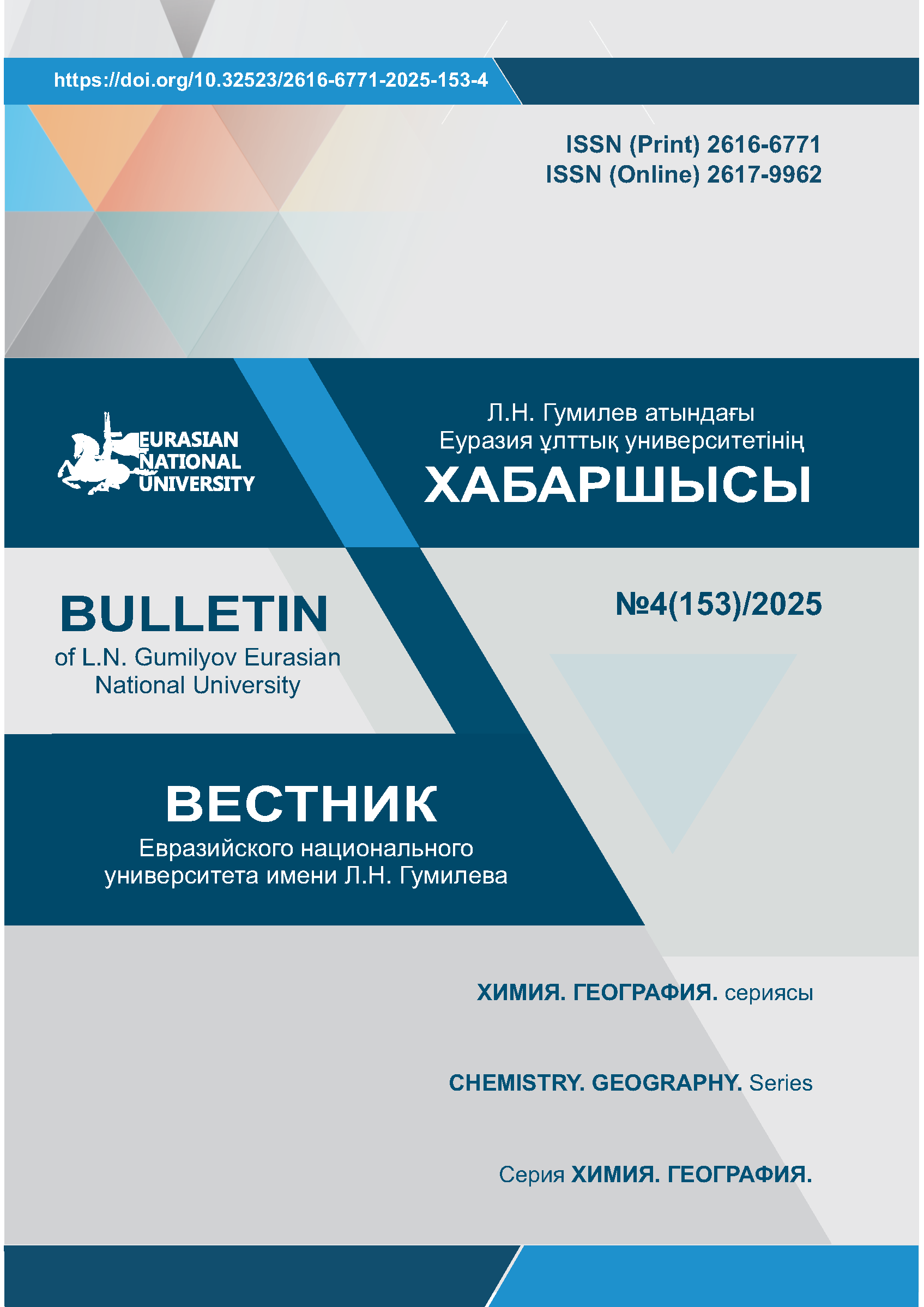
Multifunctional polyethyleneimine: physicochemical properties and modern applications
Views: 470 / PDF downloads: 222
DOI:
https://doi.org/10.32523/3107-278X-2025-153-4-56-73Keywords:
branched polyethylenimine (b-PEI), linear polyethylenimine (l-PEI), poly(2-ethyl-2-oxazoline), acid hydrolysis, anionic polymerization, cationic polymerizationAbstract
Polyethyleneimine (PEI) is a promising polymer with unique physicochemical properties, enabling its application in various fields of science and technology. This study examines the main synthesis methods of PEI, including anionic polymerization of aziridine, cationic polymerization of 2-oxazolines, and acid hydrolysis of poly(2-ethyl-2-oxazoline). The key physicochemical properties of the polymer, such as solubility, thermal stability, and complexation ability, are described. Special attention is given to the potential applications of PEI in gene therapy, water purification, and antimicrobial coatings. Furthermore, novel approaches to enhancing its biocompatibility are discussed, making this polymer a highly promising material for innovative developments.
Downloads
References
Barros, J., Dias, A., Rodrigues, M. A., Pina-Vaz, C., Lopes, M. A., & Pina-Vaz, I. (2015). Antibiofilm and antimicrobial activity of polyethylenimine: An interesting compound for endodontic treatment. Journal of Contemporary Dental Practice, 16(6), 427–432. https://doi.org/10.5005/jp-journals-10024-1701
Bauer, M., Tauhardt, L., Lambermont-Thijs, H. M. L., Kempe, K., Hoogenboom, R., Schubert, U. S., & Fischer, D. (2018). Rethinking the impact of protonable amine density on cationic polymers for gene delivery. European Journal of Pharmaceutics and Biopharmaceutics, 128, 96–106. https://doi.org/10.1016/j.ejpb.2018.10.003
Bediako, J. K., Lin, S., Sarkar, A. K., Zhao, Y., Choi, J.-W., Song, M.-H., Wei, W., Reddy, D. H. K., Cho, C.-W., & Yun, Y.-S. (2020). Benignly-fabricated crosslinked polyethylenimine/calcium-alginate fibers as high-performance adsorbents for effective recovery of gold. Journal of Cleaner Production, 252, 119389. https://doi.org/10.1016/j.jclepro.2019.119389
Boussif, O., Lezoualc’h, F., Zanta, M. A., Djavaheri Mergny, M., Scherman, D., Demeneix, B., & Behr, J. P. (1995). A versatile vector for gene and oligonucleotide transfer into cells in culture and in vivo: Polyethylenimine. Proceedings of the National Academy of Sciences, 92(16), 7297–7301.
Casper, J., Schenk, S. H., Parhizkar, E., Detampel, P., Dehshahri, A., & Huwyler, J. (2023). Polyethylenimine (PEI) in gene therapy: Current status and clinical applications. Journal of Controlled Release, 362, 667–691. https://doi.org/10.1016/j.jconrel.2023.09.001
Chen, Z., Lv, Z., Sun, Y., Chi, Z., & Qing, G. (2020). Recent advancements in polyethyleneimine-based materials and their biomedical, biotechnology, and biomaterial applications. Journal of Materials Chemistry B, 8(15), 2951–2973. https://doi.org/10.1039/C9TB02271F
Coulembier, O., Moins, S., Maji, S., Zhang, Z., De Geest, B. G., Dubois, P., & Hoogenboom, R. (2014). Linear polyethyleneimine as (multi)functional initiator for organocatalytic L-lactide polymerization. Journal of Materials Chemistry B. Advance Article. https://doi.org/10.1039/C4TB01387E
Dai, Y., & Zhang, X. (2019). MicroRNA delivery with bioreducible polyethylenimine as a non-viral vector for breast cancer gene therapy. Macromolecular Bioscience, 19(4), 1800445. https://doi.org/10.1002/mabi.201800445
de la Rosa, V. R., Bauwens, E., Monnery, B. D., De Geest, B. G., & Hoogenboom, R. (2014). Fast and accurate partial hydrolysis of poly(2-ethyl-2-oxazoline) into tailored linear polyethylenimine copolymers. Polymer Chemistry, 5(17), 4957–4964. https://doi.org/10.1039/c4py00355a
Finny, A. S., Cheng, N., Popoola, O., & Andreescu, S. (2022). 3D printable polyethyleneimine-based hydrogel adsorbents for heavy metal ions removal. Environmental Science: Advances, 1, 443–455. https://doi.org/10.1039/d2va00064d
Gleede, T., Reisman, L., Rieger, E., Mbarushimana, P. C., Rupar, P. A., & Wurm, F. R. (2019). Aziridines and azetidines: Building blocks for polyamines by anionic and cationic ring-opening polymerization. Polymer Chemistry, 10, 3257–3283.
Goncharuk, V. V., Puzyrnaya, L. N., Pshinko, G. N., Bogolepov, A. A., & Demchenko, V. Ya. (2010). The removal of heavy metals from aqueous solutions by montmorillonite modified with polyethylenimine. Journal of Water Chemistry and Technology, 32(2), 67–72. https://doi.org/10.3103/S1063455X10020013
Gosselin, M. A., Guo, W., & Lee, R. J. (2001). Efficient gene transfer using reversibly cross-linked low molecular weight polyethylenimine. Bioconjugate Chemistry, 12(6), 989–994. https://doi.org/10.1021/bc0100455
Göppert, N. E., Kleinsteuber, M., Weber, C., & Schubert, U. S. (2020). Degradable poly(2-oxazoline) analogues from partially oxidized poly(ethylene imine). Macromolecular Rapid Communications, 41(11), 1900615. https://doi.org/10.1002/marc.201900615
Guo, D.-M., An, Q.-D., Xiao, Z.-Y., Zhai, S.-R., & Shi, Z. (2017). Polyethylenimine-functionalized cellulose aerogel beads for efficient dynamic removal of chromium(VI) from aqueous solution. RSC Advances, 7, 54039–54052. https://doi.org/10.1039/c7ra09940a
Halacheva, S., Madsen, J., Ladmiral, V., Haddleton, D. M., & Howdle, S. M. (2011). Thermoresponsive behavior and self-assembly of linear poly(ethylene imine)-poly(2-ethyl-2-oxazoline) comb block copolymers. Macromolecules, 44(19), 7567–7574. https://doi.org/10.1021/ma201461e
Hao, F., Li, Y., Zhu, J., Sun, J., Marshall, B., Lee, R. J., Teng, L., Yang, Z., & Xie, J. (2019). Polyethylenimine-based formulations for delivery of oligonucleotides. Current Medicinal Chemistry, 26(13), 2264–2284. https://doi.org/10.2174/0929867325666181031094759
Hu, F., Li, Z., Xia, Y., Li, S., & Wu. C. (2014). Rare-earth triflate-initiated cationic ring-opening polymerization of 2-oxazolines: Synthesis of linear polyethyleneimine with controlled properties. Journal of Polymer Science, 52(6), 1047–1059. https://doi.org/10.1039/C4RA11404C
Huang, T., Cao, S., Luo, D., Zhang, N., Lei, Y.-Z., & Wang, Y. (2022). Polydopamine-assisted polyethylenimine grafting melamine foam and the application in wastewater purification. Chemosphere, 287, 132054. https://doi.org/10.1016/j.chemosphere.2021.132054
Huh, S.-H., Do, H.-J., Lim, H.-Y., Kim, D.-K., Choi, S.-J., Song, H., Kim, N.-H., Park, J.-K., Chang, W.-K., Chung, H.-M., & Kim, J.-H. (2007). Optimization of 25 kDa linear polyethylenimine for efficient gene delivery. Biologicals, 35(3), 165–171. https://doi.org/10.1016/j.biologicals.2006.08.004
Jiang, C., Chen, J., Li, Z., Wang, Z., Zhang, W., & Liu, J. (2019). Recent advances in the development of polyethylenimine-based gene vectors for safe and efficient gene delivery. Expert Opinion on Drug Delivery, 16, 1–15. https://doi.org/10.1080/17425247.2019.1604681
Khalaj, M., Khatami, S.-M., Kalhor, M., Zarandi, M., Anthony, E. T., & Klein, A. (2023). Polyethylenimine grafted onto nano-NiFe2O4@SiO2 for the removal of CrO42-, Ni2+, and Pb2+ ions from aqueous solutions. Molecules, 29(1), 125. https://doi.org/10.3390/molecules29010125
Lambermont-Thijs, H. M. L., van der Woerdt, F. S., Baumgaertel, A., Bonami, L., Du Prez, F. E., Schubert, U. S., & Hoogenboom, R. (2010). Linear poly(ethylene imine)s by acidic hydrolysis of poly(2-oxazoline)s: Kinetic screening, thermal properties, and temperature-induced solubility transitions. Macromolecules, 43(2), 927–933. https://doi.org/10.1021/ma9020455
Liu, J., Su, D., Yao, J., Huang, Y., Shao, Z., & Chen, X. (2017). Soy protein-based polyethylenimine hydrogel and its high selectivity for copper ions removal in wastewater treatment. Journal of Materials Chemistry A. Advance online publication. https://doi.org/10.1039/C6TA10814H
Liu, M., Li, J., & Li, B. (2018). Mannose-modificated polyethylenimine: A specific and effective antibacterial agent against Escherichia coli. Langmuir, 34(5), 1574–1580. https://doi.org/10.1021/acs.langmuir.7b03556
Ma, Y., Zhang, B., Ma, H., Yu, M., Li, L., & Li, J. (2016). Electrospun nanofibrous polyethylenimine mat: A potential adsorbent for the removal of chromate and arsenate from drinking water. RSC Advances, 6, 30739–30746. https://doi.org/10.1039/c5ra26973c
Maurisse, R., De Semir, D., Emamekhoo, H., Bedayat, B., Abdolmohammadi, A., Parsi, H., & Gruenert, D. C. (2010). Comparative transfection of DNA into primary and transformed mammalian cells from different lineages. BMC Biotechnology, 10, 9. https://doi.org/10.1186/1472-6750-10-9
Mayandi, V., Sridhar, S., Fazil, M. H. U. T., Goh, E. T. L., Htton, H. M., Orive, G., Choong, Y.K., Saravanan R., Beuerman, R. W., Barkham, T., Yang, L., Baskaran, M., Jhanji, V., Loh, X. J., Verma, N. K., & Lakshminarayanan, R. (2019). Protective action of linear polyethylenimine against Staphylococcus aureus colonization and exaggerated inflammation. ACS Infectious Diseases, 5(8), 1411–1420. https://doi.org/10.1021/acsinfecdis.9b00102
Mees, M. A. (2017). Poly(2-alkyl-2-oxazoline)s and poly(ethylene imine): How one thing led to the other [Doctoral dissertation, Ghent University, Belgium]. Ghent University Academic Bibliography. https://biblio.ugent.be/publication/8516651
Mees, M. A., & Hoogenboom, R. (2018). Full and partial hydrolysis of poly(2-oxazoline)s and subsequent post-polymerization modification. Polymer Chemistry, 9, 4957–4964. https://doi.org/10.1039/C8PY00978C
Neuberg, P., & Kichler, A. (2014). Recent developments in nucleic acid delivery with polyethylenimines. In T. Friedmann (Ed.), Advances in Genetics (Vol. 88, pp. 263–284). Elsevier. https://doi.org/10.1016/B978-0-12-800148-6.00009-2
Nuzhdina, A. V., Morozov, A. S., Kopitsyna, M. N., Strukova, E. N., Shlykova, D. S., Bessonov, I. V., & Lobakova, E. S. (2017). Simple and versatile method for creation of non-leaching antimicrobial surfaces based on cross-linked alkylated polyethyleneimine derivatives. Materials Science and Engineering: C, 70, 788–795. https://doi.org/10.1016/j.msec.2016.09.033
Pandey, R., Pinon, V., Garren, M., Maffe, P., Mondal, A., Brisbois, E. J., & Handa, H. (2024). N-acetyl cysteine-decorated nitric oxide-releasing interface for biomedical applications. ACS Applied Materials & Interfaces, 16, 24248–24260. https://doi.org/10.1021/acsami.4c02369
Pang, Y., Zeng, G., Tang, L., Zhang, Y., Liu, Y., Lei, X., Li, Z., Zhang, J., & Xie, G. (2011). PEI-grafted magnetic porous powder for highly effective adsorption of heavy metal ions. Desalination, 281(1), 278–284. https://doi.org/10.1016/j.desal.2011.08.001
Petit, C., Grassl, B., Mignard, E., Luef, K. P., Wiesbrock, F., & Reynaud, S. (2017). Cationic ring-opening polymerization of 2-oxazolines in ionic liquids and microfluidic reactors for fast and controlled polymerization. Macromolecular Chemistry and Physics, 218(16), 1700253. https://doi.org/10.1039/C7PY01255A
Priyam, A., Nagar, P., Sharma, A. K., & Kumar, P. (2017). Mussel-inspired polydopamine-polyethylenimine conjugated nanoparticles as efficient gene delivery vectors for mammalian cells. Colloids and Surfaces B: Biointerfaces. Advance online publication. https://doi.org/10.1016/j.colsurfb.2017.10.063
Rosenkranz, A. A., & Sobolev, A. S. (2015). Polyethylenimine-based polyplex nanoparticles and features of their behavior in cells and tissues. Russian Chemical Bulletin, International Edition, 64(12), 2749–2755.
Rupar, P. A., Reisman, L., & Mbarushimana, P. C. (2017). Synthesis of linear polyethyleneimine by living anionic polymerization (U.S. Patent Application No. US20170204224A1). U.S. Patent and Trademark Office.
Sedlacek, O., Janoušková, O., Verbraeken, B., & Hoogenboom, R. (2018). Superhydrophilic poly(2-oxazoline)s via acylation of polyethylenimine. Biomacromolecules. Advance online publication. https://doi.org/10.1021/acs.biomac.8b01366
Shan, X., Williams, A. C., & Khutoryanskiy, V. V. (2020). Polymer structure and property effects on solid dispersions with haloperidol: Poly(N-vinyl pyrrolidone) and poly(2-oxazolines) studies. International Journal of Pharmaceutics, 590, 119884. https://doi.org/10.1016/j.ijpharm.2020.119884
Socia, A., Liu, Y., Zhao, Y., Abend, A., & Wuelfing, W. P. (2020). Development of an ultra-high-performance liquid chromatography-charged aerosol detection/UV method for the quantitation of linear polyethylenimines in oligonucleotide polyplexes. Journal of Separation Science, 43(24), 4421–4429. https://doi.org/10.1002/jssc.202000414
Sun, X., Yang, L., Li, Q., Liu, Z., Dong, T., & Liu, H. (2015). Polyethylenimine-functionalized poly(vinyl alcohol) magnetic microspheres as a novel adsorbent for rapid removal of Cr(VI) from aqueous solution. Chemical Engineering Journal, 262, 101–108. https://doi.org/10.1016/j.cej.2014.09.045
Tanaka, R., Ueoka, I., Takaki, Y., Kataoka, K., & Saito, S. (1983). High molecular weight linear poly(ethyleneimine) and poly(N-methylethylenimine). Macromolecules, 16(6), 849–853.
Tauhardt, L., Kempe, K., Knop, K., Altuntaş, E., Jäger, M., Schubert, S., Fischer, D., & Schubert, U. S. (2011). Linear polyethyleneimine: Optimized synthesis and characterization - on the way to pharmagrade batches. Macromolecular Chemistry and Physics, 212(19), 1918–1924. https://doi.org/10.1002/macp.201100190
Weyts, K. R., & Goethals, E. J. (1988). New synthesis of linear polyethyleneimine. Polymer Bulletin, 19(1), 13–19.
Wong, S., Abd Ghafar, N., Ngadi, N., Razmi, F. A., Inuwa, I. M., Mat, R., & Saidina Amin, N. A. (2020). Effective removal of anionic textile dyes using adsorbent synthesized from coffee waste. Scientific Reports, 10, 2928. https://doi.org/10.1038/s41598-020-60021-6
Xanthopoulou, M., & Katsoyiannis, I. A. (2023). Enhanced adsorption of chromate and arsenate ions from contaminated water with emphasis on polyethylenimine modified materials: A review. Separations, 10, 441. https://doi.org/10.3390/separations10080441
Xing, M., Zhang, H., Li, Z., Zhang, L., & Qian, W. (2024). Long-lasting renewable antibacterial N-halamine coating enable dental unit waterlines to prevention and control of contamination of dental treatment water. Frontiers in Materials, 11, 1399597. https://doi.org/10.3389/fmats.2024.1399597
Yadav, S., & Kumar, P. (2018). Enhanced uptake of plasmid at boronic acid decorated linear polyethylenimines results in higher transfection efficiency. Biointerphases, 13(6), 061003. https://doi.org/10.1116/1.5054930
Yu, B., Zhang, Y., Zheng, W., Fan, C., & Chen, T. (2022). Polyethyleneimine-based drug delivery systems for cancer theranostics. ACS Macro Letters, 11(8), 1043–1056. https://doi.org/10.1021/acs.macromol.2c01308
Zakeri, A., Kouhbanani, M. A. J., Beheshtkhoo, N., Beigi, V., Mousavi, S. M., Hashemi, S. A. R., Zade, A. K., Amani, A. M., Savardashtaki, A., Mirzaei, E., Jahandideh, S., & Movahedpour, A. (2018). Polyethylenimine-based nanocarriers in co-delivery of drug and gene: A developing horizon. Nano Reviews & Experiments, 9(1), 1488497. https://doi.org/10.1080/20022727.2018.1488497
Zeng, H., Wang, L., Zhang, D., Yan, P., Nie, J., Sharma, V. K., & Wang, C. (2019). Highly efficient and selective removal of mercury ions using hyperbranched polyethylenimine functionalized carboxymethyl chitosan composite adsorbent. Chemical Engineering Journal. Advance online publication. https://doi.org/10.1016/j.cej.2018.10.001
Zhuk, D. S., Gembitskii, P. A., & Kargin, V. A. (1965). Advances in the chemistry of polyethyleneimine (polyaziridine). Russian Chemical Reviews, 34(7), 515–525.
Zou, Y., Li, D., Shen, M., & Shi, X. (2019). Polyethylenimine-based nanogels for biomedical applications. Macromolecular Bioscience, 19(9), 1900272. https://doi.org/10.1002/mabi.201900272
von Zelewsky, A., Barbosa, L., & Schläpfer, C.-W. (1993). Poly(ethylenimines) as Brønsted bases and as ligands for metal ions. Coordination Chemistry Reviews, 123, 229–246.
Downloads
Published
Issue
Section
License
Copyright (c) 2025 T. Nurlibayeva, G. Abilova, Zh. Makhambetova, Z. Sultamuratova, G. Zhakupova (Author)

This work is licensed under a Creative Commons Attribution-NonCommercial 4.0 International License.